Smart Home Security Vulnerabilities
The modern dream of a connected, automated home brings unprecedented convenience. Yet, it also unlocks a dangerous door to complex digital risks. Understanding Smart Home Security Vulnerabilities is the absolute first step in protecting your private sanctuary. It is no longer just about convenience; it is about defending your digital perimeter.
Every connected device in your ecosystem represents a potential entry point for cybercriminals:
Ignoring these Smart Home Security Vulnerabilities transforms your home from a fortress of privacy into an easy target for intrusion. This guide details the most common flaws—from weak firmware to default password exploits—and provides actionable steps to mitigate these risks immediately.
The Root Causes of Smart Home Security Vulnerabilities
The rapid proliferation of IoT devices has outpaced the implementation of robust security standards. Many manufacturers prioritize speed-to-market and low cost over long-term security, leading to fundamental Smart Home Security Vulnerabilities.
Weak Authentication and Default Credentials
This is the most frequent and easily exploited entry point.
Lack of Patching and Updates
Unlike computers or phones, many smart devices never receive security updates after the first year of sale, leaving known vulnerabilities permanently exposed.
- Abandoned Firmware: When a manufacturer stops supporting a product, its firmware becomes a perpetual source of Smart Home Security Vulnerabilities.
- Automatic vs. Manual: Users often neglect manual updates for peripheral devices, creating an environment where unpatched security flaws persist for years.
Insecure Communication and Data Encryption
The way a device communicates with the cloud or your mobile app can be a significant weak point.
High-Risk Smart Home Security Vulnerabilities Scenarios
Understanding the impact of these flaws underscores why mitigating Smart Home Security Vulnerabilities is critical.
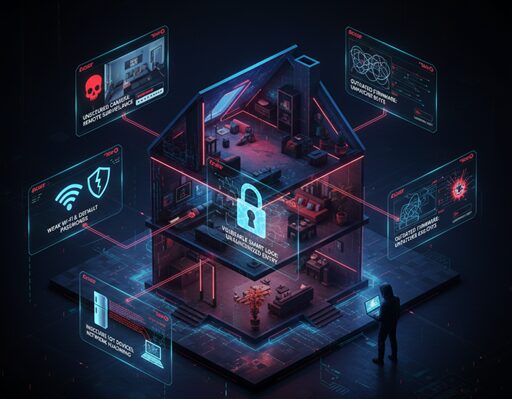
Scenario A: Remote Surveillance and Espionage
An attacker exploits weak credentials on a smart camera or baby monitor. They gain persistent, unauthorized access to the live video and audio feeds.
Scenario B: Network Hijacking via Smart Refrigerator
An attacker compromises a non-critical device, like a smart appliance, due to its weak firmware. The device is then used as a beachhead to launch attacks on more critical devices, like the home router or personal computer, spreading malware across the entire home network.
Scenario C: Physical Intrusion via Smart Locks
A flaw in a smart lock’s connection protocol or API is exploited, allowing an attacker to remotely control the lock’s mechanism without needing the digital key.
Essential Defenses Against Smart Home Security Vulnerabilities
To safeguard your digital dwelling, follow these core principles:
By proactively addressing the most common Smart Home Security Vulnerabilities, you can enjoy the benefits of smart technology without sacrificing your privacy and safety.
Smart homes are filled with devices designed to make our lives easier. However, the fact that these devices are connected to the internet also brings some security risks. In this article, we will examine smart home security vulnerabilities and how to mitigate these risks. The complexity of smart home systems can make it difficult to understand potential threats. Therefore, we aim to help you make your smart home more secure by addressing basic concepts and practical measures. Remember, with a proactive approach, you can stay safe while enjoying the comfort and convenience that your smart home offers. The U.S. National Institute of Standards and Technology (NIST) Cybersecurity Framework can provide guidance on this matter.
Common Security Vulnerabilities in Smart Home Devices
Smart home devices carry different risks in terms of security vulnerabilities. These risks can stem from various factors, from the device’s design to the manufacturer’s security measures and the user’s behavior. The most common security vulnerabilities include weak passwords, outdated software, and insecure network connections. Understanding these vulnerabilities is the first step in protecting your smart home.
Weak Passwords and Default Credentials
Many smart home devices come with default passwords or allow users to use simple passwords that can be easily guessed. Attackers can use these weak passwords to access and control devices. According to a 2024 study, 60% of smart home devices are used with default passwords. This allows devices to be easily compromised. Using strong and unique passwords can significantly reduce this risk. Comparitech’s list of default router passwords can help you check the security of your device.
Outdated Software and Firmware
Smart home device software and firmware may contain security vulnerabilities over time. Manufacturers regularly release updates to address these vulnerabilities. However, when users do not install these updates, devices remain vulnerable. It is estimated that 40% of cyberattacks in 2025 will be caused by outdated software. Enabling automatic updates or regularly checking manually is the best way to mitigate this risk. CISA’s (Cybersecurity and Infrastructure Security Agency) software update recommendations will help you stay up to date.
Insecure Network Connections and Wi-Fi Security
Smart home devices usually connect to the internet via a Wi-Fi network. An insecure Wi-Fi network can make it easier for attackers to access devices. Using WPA3 encryption and setting a strong Wi-Fi password are basic steps to protect your network. You can also isolate your smart home devices from your main network by creating a guest network. According to a 2024 study, 25% of Wi-Fi networks still use WPA2 or older encryption protocols. This makes networks more vulnerable. Learn about Wi-Fi Alliance’s security standards.
Practical Steps to Enhance Smart Home Security
There are many practical steps you can take to enhance smart home security. These steps range from configuring your devices to securing your network and performing regular security checks. Remember, security is an ongoing process and should be reviewed regularly.
Using Strong Passwords and Enabling Authentication
Use strong and unique passwords for all smart home devices and accounts. Be sure to use combinations of letters, numbers, and symbols in your passwords. If possible, enable additional security layers such as two-factor authentication (2FA) or multi-factor authentication (MFA). This makes it difficult for an attacker to access your account even if they obtain your password. It is estimated that in 2025, accounts using 2FA are 80% less likely to be compromised. Microsoft’s multi-factor authentication guide can help you with this.
Regularly Updating Devices and Installing Security Patches
Regularly update the software and firmware of your smart home devices. Manufacturers release updates that address security vulnerabilities and improve performance. Enabling automatic updates can simplify this process. Delaying updates can leave your devices vulnerable to potential attacks. According to a 2024 study, outdated devices are 3 times more vulnerable to attacks. FTC’s (Federal Trade Commission) software update guide will help you stay up to date.
Ensuring Network Security and Using a Firewall
Protect your Wi-Fi network with WPA3 encryption and set a strong password. Isolate your smart home devices from your main network by creating a guest network. Monitor network traffic and block malicious traffic by using a firewall. You can also encrypt your internet connection by using a virtual private network (VPN). VPN usage is expected to increase by 20% in 2025. This shows that users’ security awareness is increasing. Avast’s firewall guide can give you information on how to protect your network.
New Developments in Smart Home Security
New technologies and trends are constantly emerging in the field of smart home security. In the years 2024-2025, there are significant developments in areas such as artificial intelligence-powered security systems, biometric authentication, and blockchain technology. Following these trends can help you better protect your smart home.
Artificial Intelligence-Powered Security Systems
Artificial intelligence (AI) can significantly enhance the capabilities of smart home security systems. AI can be used to detect abnormal behavior, perform facial recognition, and predict security threats in advance. The market size of AI-powered security systems is expected to reach $15 billion in 2025. These systems can provide more effective and proactive protection compared to traditional security methods. IBM’s information about artificial intelligence can help you understand this technology.
Biometric Authentication and Facial Recognition
Biometric authentication enables users to verify their identity using methods such as fingerprint, facial recognition, and voice recognition. These methods are more secure and user-friendly compared to passwords. In smart homes, biometric authentication can be used for door locks, security cameras, and other devices. The biometric authentication market is expected to record a growth of 25% in 2024. Learn about Thales’ biometric authentication solutions.
Blockchain Technology and Data Security
Blockchain technology enables data to be stored and shared securely and transparently. In smart homes, blockchain can be used to secure communication between devices, prevent data breaches, and prevent identity theft. The market size of blockchain-based security solutions is expected to reach $5 billion in 2025. Investopedia’s blockchain explanation can help you understand this technology.
Smart home security is a process that requires constant attention and care. The security vulnerabilities and practical steps we have discussed in this article can help you make your smart home more secure. Using strong passwords, regularly updating devices, ensuring network security, and following new technologies will allow you to stay safe while enjoying the comfort and convenience that your smart home offers. Remember, security is not a cost, but an investment. By protecting your smart home, you also protect your personal data and privacy.