Converged Security

Beyond the Firewall – How Physical Access Control is Your Last, and Most Critical, Line of Data Defense

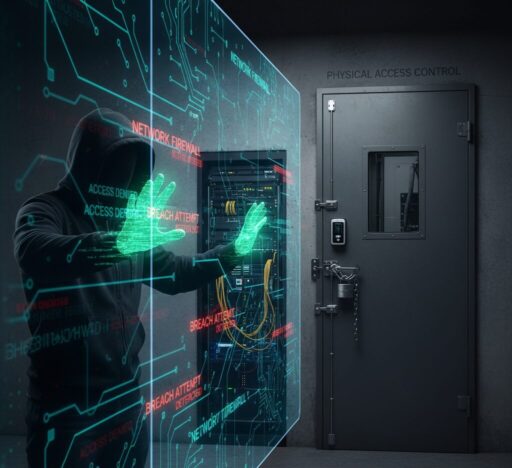
In the high-stakes world of cybersecurity, organizations spend millions fortifying their digital perimeters with advanced firewalls, intrusion detection systems, and encryption protocols. Yet, a fundamental truth often gets overlooked: the most sophisticated digital defenses can be instantly bypassed by a simple, unauthorized walk-in. The critical, often neglected, component of a complete security strategy lies beyond the firewall—specifically, in robust physical access control. This is the final and most crucial barrier protecting your servers, network hardware, and employee workstations from direct compromise.


The Blurring Lines: Physical Intrusion as a Data Breach Vector

As discussed in earlier security analyses, a physical break-in often serves as the initial vector for a data breach. An intruder who gains physical access to a server room or an unlocked desktop doesn’t need to defeat complex digital security measures; they can simply:

  • Directly Access Network Ports: Plugging into an internal network port to bypass perimeter firewalls entirely.
  • Use Malicious Devices: Inserting a pre-loaded USB drive or a hardware keylogger to capture credentials.
  • Perform “Shoulder Surfing”: Gaining passwords or access codes by direct observation.

In these scenarios, the damage occurs beyond the firewall, rendering all digital defenses irrelevant. Therefore, focusing solely on the digital side is a strategic failure.


The Pillars of Physical Access Control

Implementing strong physical security is about creating layers of defense that work in tandem with digital security. Here are the essential elements that define protection beyond the firewall:

Biometric and Card Access Systems

Modern access control relies on multi-factor authentication for physical entry. Key features include:

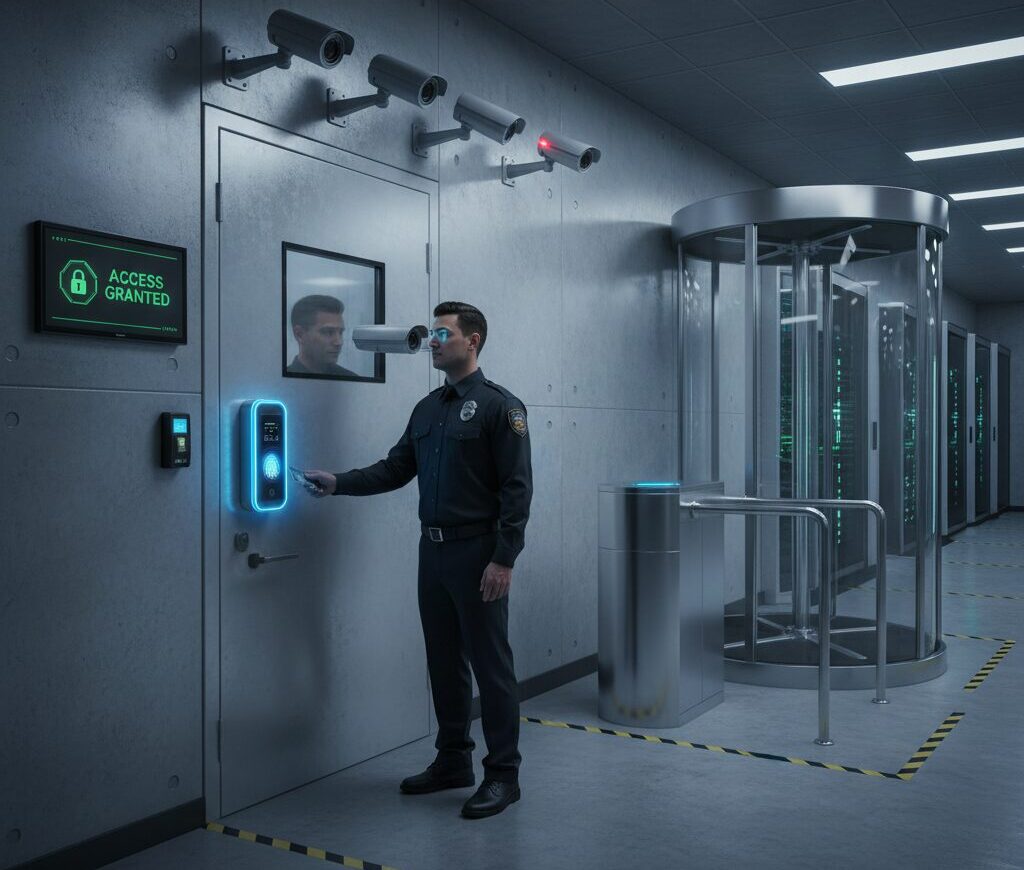
  • Multi-Factor Entry: Requiring both a physical access card (what you have) and a PIN or biometric scan (what you are).
  • Time-Sensitive Access: Restricting access to sensitive areas (like data centers) only to authorized personnel during specified hours.

Comprehensive Surveillance and Alarm Systems

Surveillance is not just about recording; it’s about real-time deterrence and forensic evidence collection. High-definition cameras, coupled with smart analytics, can alert security personnel to anomalies before a breach is complete. This monitoring is vital for understanding events that occur beyond the firewall and aiding in Post-Breach Forensics.

Strict Visitor and Tailgating Protocols

One of the easiest ways for attackers to get beyond the firewall is by simply following an authorized employee (tailgating). Strict protocols, including mantrap security areas and mandatory badging for all personnel (including employees and guests), eliminate this vulnerability. All visitors must be logged, escorted, and their access terminated immediately upon departure.


Integrating Physical and Digital Security

The security posture of an organization is only as strong as its weakest link. In 2025, a complete defense strategy must explicitly connect physical and digital security logs. An attempt to disable a magnetic lock should trigger an alert just as aggressively as a brute-force attack on a server. By viewing physical access control as the last, and arguably most important, defense layer beyond the firewall, organizations can achieve truly resilient security against hybrid threats.

Your cybersecurity stack is impressive, but your server room door isn’t. Discover why Physical Access Control (PAC) isn’t just about security—it’s a core strategy for protecting your revenue, ensuring compliance, and defending your bottom line.

You’ve spent a fortune on your digital fortress.

You have next-generation firewalls (NGFWs), endpoint detection and response (EDR), multi-factor authentication (MFA) on every cloud app, and an AI-powered SIEM solution that scans for anomalies 24/7. Your CISO assures you that your network perimeter is “locked down.”

But what about your front door? What about the server room closet?

In 2024, we are so focused on battling sophisticated digital threats from across the globe that we’ve overlooked the simplest, most devastating vulnerability of all: a person walking right into your building.
Beyond the Firewall - How Physical Access Control is Your Last, and Most Critical, Line of Data Defense

If your data is the new oil, your server room is the vault. Your firewall is designed to stop digital thieves from tunneling in, but it’s completely useless if someone can just walk in, plug in a $10 USB drive, and walk out.

This is why Physical Access Control (PAC) is no longer a “facilities issue”—it is your last and most critical line of data defense. And ignoring it is one of the most expensive mistakes your business can make.

When Your $100,000 Firewall is Defeated by a $10 Lock

The disconnect between cybersecurity and physical security is a C-suite blind spot, and it’s a costly one. We treat them as separate domains. The IT department manages the firewalls, while the facilities manager handles the keys. This siloed thinking is a goldmine for attackers.

A data breach is a data breach, whether it comes through a phishing email or a propped-open door. The financial and legal consequences are identical.

  • The Insider Threat: The 2024 Verizon Data Breach Investigations Report (DBIR) consistently highlights that a significant percentage of breaches involve an insider—not always malicious, but often negligent. An employee with access they shouldn’t have, a disgruntled contractor, or even a cleaner.
  • The Social Engineer: The “attacker” might not even be an employee. They could be a social engineer posing as an IT technician, an HVAC repair person, or a delivery driver who “just needs to drop this package in the mailmailroom.” Without a physical access control system to stop, challenge, and track them, your digital defenses are irrelevant.
Beyond the Firewall - How Physical Access Control is Your Last, and Most Critical, Line of Data Defense
beyond the firewall

The Real Cost of a “Low-Tech” Breach

This isn’t about the theoretical risk; it’s about cold, hard cash. Investing in PAC is not an expense; it’s an insurance policy against catastrophic financial loss. According to IBM‘s 2024 “Cost of a Data Breach” report, the global average cost of a data breach has hit $4.5 million.

Let’s break down how a physical breach directly attacks your revenue:

  • Massive Regulatory Fines (The Compliance Hammer):
  • GDPR, HIPAA, CCPA, PCI-DSS: These regulations don’t care how the data was leaked. If unauthorized personnel accessed a server holding protected health information (PHI) or customer credit card data, you are in breach.
  • The Penalty: Fines can be up to 4% of your global annual revenue. This alone can shutter a business.
  • Devastating Business Disruption (The Revenue Killer):
  • A physical attack on a server room can mean more than just data theft; it can mean physical destruction or a ransomware attack deployed directly via USB.
  • The Cost of Downtime: Every minute your systems are offline, your e-commerce site isn’t selling, your employees can’t work, and your production line stops. The revenue loss is immediate and compounds by the hour.
  • Total Loss of Customer Trust (The Silent Killer):
  • Imagine the press release: “Our company’s data was breached because an unauthorized individual gained access to our server room.”
  • Customers will not trust you with their data. Partners will review their contracts. Your brand reputation, built over years, can be permanently tarnished, cratering future sales.

Beyond the Lock and Key: What a Modern PAC Strategy Looks Like

This isn’t your grandfather’s key-and-lock system. Modern Physical Access Control is a sophisticated, data-driven ecosystem designed to protect high-value assets.

A robust, profit-protecting PAC strategy integrates these components:

  • Layered Security (“The Onion”): Don’t just protect the front door. Your most sensitive areas—the server room, R&D labs, executive offices—must have their own, more restrictive layer of access.
  • The Principle of Least Privilege (Physical Edition): Your digital systems use this, so why not your building? An employee in marketing should not be able to badge into the server room. A modern PAC system allows you to grant granular access by role, time of day, and specific location.
  • Biometrics and Mobile Access: For your “crown jewels” (the data center), a key card isn’t enough. It can be lost or stolen. Requiring two-factor authentication—something you have (a mobile credential) and something you are (a fingerprint or face scan)—makes this last line of defense nearly impenetrable.
  • The Unbreakable Audit Trail: This is the most crucial part for your bottom line. If a breach does occur, your PAC system provides an exact, time-stamped log of who entered what door and when. This digital evidence is vital for:
  • Incident Response: Instantly identifying “patient zero” of the breach.
  • Legal & Compliance: Proving to auditors and regulators that you had “due care” measures in place, significantly reducing your liability and potential fines.

Your Call to Action: Stop Guarding Only the Digital Door

Stop and ask yourself this:

“Am I spending millions to protect my data from a digital attack in Russia, while leaving it vulnerable to a $20 fake ID and a confident smile at my front desk?”

Your firewall is your first line of defense, but it’s not your only one. Your Physical Access Control system is your last, most tangible stand against data loss. It’s the difference between a minor security incident and a $4.5 million catastrophe.

Don’t wait for a physical breach to expose your digital blind spot. The time to audit your server room access, upgrade your credentials, and integrate your physical security into your overall data defense strategy is now.

Similar Posts

  • Why San Diego Gated Communities Need Security Guards

    While the physical barrier of a gate provides an initial sense of exclusivity and safety, San Diego’s affluent, desirable gated communities quickly realize they need security guards to achieve true, comprehensive protection. The gate itself is merely a tool; the human element of a professional security guard service transforms that barrier into an active, intelligent defense system. In a dynamic, high-value area like San Diego, relying solely on automated systems leaves residents vulnerable to tailgating, sophisticated intrusion, and internal security lapses.

  • Biometrics in 2026 – Is Facial Recognition the Key to Ultimate Security or a Privacy Nightmare?

    The discussion around security and privacy is reaching a fever pitch, and at its center is the rapid deployment of biometric technologies. Biometrics in 2026 represents a pivotal moment where facial recognition, fingerprint scans, and iris authentication are transitioning from niche security tools to pervasive elements of daily life. While proponents hail facial recognition as the ultimate key to swift, immutable identity verification and heightened security, critics warn that its widespread use heralds an unprecedented era of surveillance and privacy erosion. Understanding the dual nature of Biometrics in 2026 is essential for shaping its ethical future.

  • Securing the Remote Workforce – A New Role for Physical Security Teams?

    Securing the Remote Workforce is no longer just an IT or cybersecurity challenge; it’s a holistic security imperative that is redefining the roles and responsibilities of physical security teams. The massive, enduring shift to remote work has shattered the traditional security perimeter, creating a distributed landscape where the “office” is now hundreds or thousands of individual homes. This new environment demands that security leaders reassess who is responsible for protecting organizational assets, both digital and physical, for the increasingly dispersed remote workforce.

  • What is an X-Ray Device? Where is it used?

    X-ray devices, which have an important place in modern security systems, stand out especially with their ability to detect threats quickly and effectively. These devices, which are used in many areas from airports to public buildings, from courthouses to private security points, are of great importance in terms of both ensuring life safety and accelerating operational processes. We have discussed the types and usage areas of x-ray devices in this content.

  • The 5 Best Crypto Hardware Wallets – Our Top Picks for Securing Your Assets

    With the crypto market booming, is your portfolio actually safe? The reality is, cold storage is your only true defense against hacks and malware. Securing your investment starts with choosing one of the best crypto hardware wallets available. The 2025 lineup brings game-changing security chips and smoother interfaces, making the race for the ultimate hardware wallet tighter than ever. Here is why you need to upgrade now.