Facial Recognition Tech: Unmasking Its Hidden Flaws and Risks
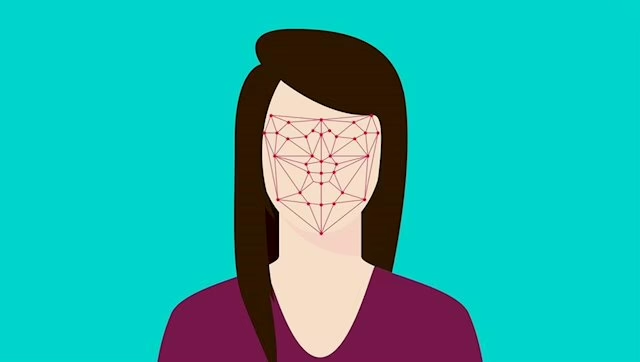
Facial recognition technology has made leaps and bounds, thanks to machine learning and artificial intelligence. These systems can now create lifelike images of human faces from scratch, using massive datasets of real images to learn and generate original content. However, recent incidents have exposed significant vulnerabilities in this technology.
Outsmarting the System
At the yearly Black Hat USA conference, McAfee researchers demonstrated how AI technology could be used to deceive facial recognition systems. By feeding a machine learning system 1,500 photos of two individuals, they created fake images that combined the facial features of both subjects. Over time, the system produced images that fooled the facial recognition system, misidentifying one individual as another.
Real-World Dangers
Steve Povolny, head of advanced threat research at McAfee, explained that this type of attack is not just theoretical. An attacker could submit a fake image of an accomplice for a passport application, which would then be stored in the passport database. If a live photo of the attacker is taken at an automated passport-verification kiosk, the system could identify the attacker as the accomplice, posing serious security risks.
McAfee’s Generative Adversarial Networks
The research involved the use of a Generative Adversarial Network (GAN) tool known as CycleGAN. GANs are AI neural networks that can create data similar to the input data. For instance, a GAN can generate fake but realistic images of human faces using a set of real images. CycleGAN, specifically, is used for image-to-image translation, focusing on significant features like eye placement and head shape.
The Risks of CycleGAN
Facial recognition technology is increasingly used by law enforcement agencies to identify suspects. McAfee’s research aimed to understand the potential implications and risks of this technology. The study underscored the need for better regulation and security measures to prevent misuse, as the technology could be exploited to frame innocent individuals or evade detection.
Protecting Your Privacy
Facial recognition technology raises significant privacy concerns. Companies like Clearview AI have developed applications that can analyze photos and provide extensive information about individuals. To safeguard your privacy, consider the following steps:
Securing Your Business
Businesses using facial recognition technology can take several steps to reduce the likelihood of attacks:
The Path Ahead
While facial recognition technology offers benefits in authentication and security, it is crucial to be aware of its vulnerabilities. Hackers and security researchers are continually finding ways to bypass these systems. By staying informed and advocating for better regulation, individuals and businesses can help mitigate the risks associated with facial recognition technology.