Boost Your Database Security: Crush SQL Injections with Stored Procedures!
Understanding SQL Injection
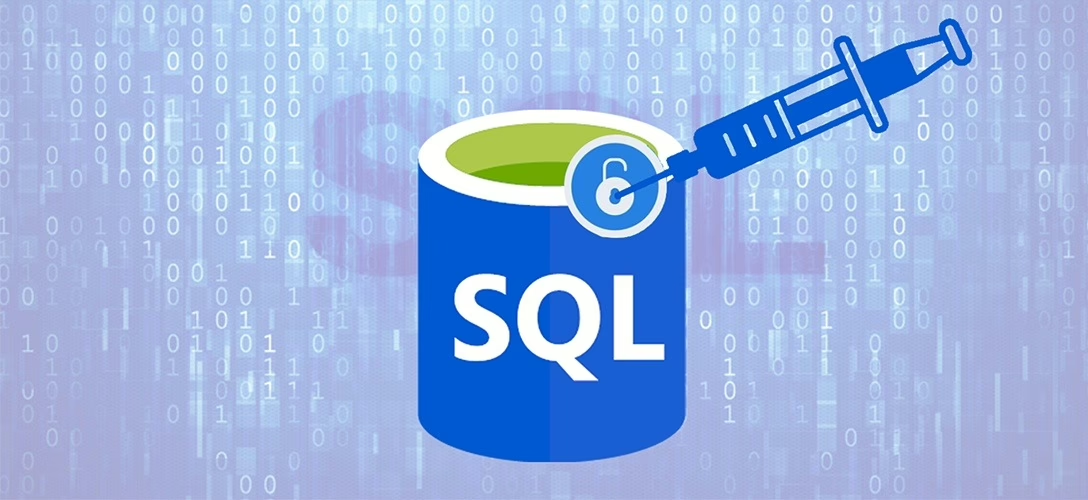
SQL Injection is a serious security threat that lets hackers send unauthorized SQL queries to a database. By exploiting this vulnerability, they can access sensitive data and manipulate database records, such as adding, deleting, or modifying information. The OWASP Top 10 2017 lists SQL Injection as one of the most severe security risks.
How SQL Injection Attacks Happen
Imagine an attacker with the IP address 192.168.35.1 targeting a web application running on an IIS server at 192.168.35.149. The attacker focuses on the ‘id’ parameter of the ‘blog.aspx’ page to send malicious SQL queries to a MSSQL server located at 192.168.35.150.
By injecting a single quote into the ‘id’ parameter, the attacker triggers an error message from the SQL server. This occurs because the web application interprets the input as part of the SQL query, causing a syntax error. Attackers can then append additional queries to the ‘id’ parameter to execute their own SQL commands.
Stored Procedures: Your SQL Injection Shield
Stored Procedures are precompiled SQL code snippets designed to execute specific SQL queries. They offer performance benefits and, when properly implemented, can prevent SQL Injection attacks. This is because stored procedures treat user inputs as values rather than executable code.
Creating a Secure Stored Procedure
To create a secure stored procedure, define a numerical variable ‘@id’ and string variables ‘@sqlcmd’ and ‘@params’. The ‘@id’ variable receives input from the web application, while ‘@sqlcmd’ and ‘@params’ define the SQL query and the data type of ‘@id’. Using the built-in ‘sp_executesql’ stored procedure ensures that user inputs are treated as values, preventing SQL Injection.
For example, if an attacker injects ‘1;DROP TABLE dbo.music–‘ into the ‘id’ parameter, the ‘sp_executesql’ procedure will reject the input because it is not a numerical value. This prevents the SQL Injection attack from executing.
Implementing the Stored Procedure in C#
To call the stored procedure from a web application, use C# code to pass the ‘id’ parameter as a value. This ensures that any non-numerical input will be rejected by the SQL server, preventing SQL Injection attacks.
When the web application is run with this implementation, any attempt to inject SQL queries into the ‘id’ parameter will result in an error. This error is not due to a SQL Injection vulnerability but rather because the input is not a numerical value. Tools like SQLMAP will not be able to exploit this vulnerability.