AI Security Cameras – Are They Smart Enough to Stop a Real Criminal?
The rise of AI Security Cameras promises a revolution in physical security, moving surveillance from mere recording devices to intelligent, proactive defense systems. But the critical question remains: are AI Security Cameras truly smart enough to detect, deter, and ultimately stop a sophisticated criminal? While traditional cameras passively capture events, the new generation of AI Security Cameras uses deep learning to analyze behavior in real-time, offering capabilities that are transforming how we think about security—but they are not without limitations. This article explores the cutting edge of this technology and determines whether your investment in AI Security Cameras is paying off in real-world protection.
What AI Security Cameras Can Do?
The primary distinction between standard CCTV and AI Security Cameras is the ability to process visual data autonomously, significantly reducing false positives and accelerating response times.
The Superpowers of AI-Powered CCTV Cameras
Intelligent Object Identification (Object Recognition): It doesn’t just see movement; it knows if it’s a “threat or a cat.” Instantly recognizes and categorizes objects like vehicles, bags, or animals, bringing “pinpoint accuracy” to your security viewing and response.
Automated License Plate Reading (LPR): Records the “digital fingerprint” of every vehicle in seconds. High-speed and accurate plate recognition automatically monitors authorized/unauthorized entry and exit, sharpening access control and parking management.
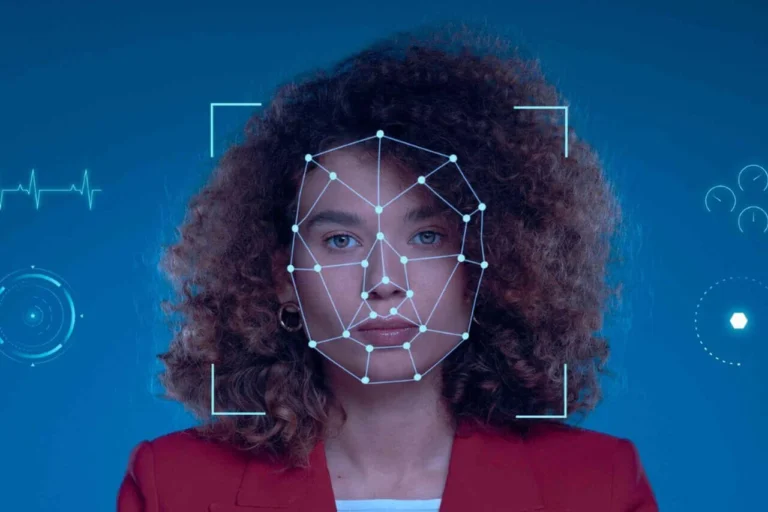
Facial Verification & Watchlist Alert (Facial Recognition): It acts as your facility’s “digital VIP list.” Instantly detects people on a secure watch list and alerts you, proactively preventing unauthorized individuals from entering the premises before they cross the threshold.
Continuous Tracking (Object Detection): Guarantees “never losing sight.” Seamlessly follows moving objects or individuals across multiple camera views, ensuring comprehensive coverage so no event slips out of the monitored area.
Perimeter Breach Detection (Intrusion Detection): A virtual sentinel guarding your “security boundaries.” Detects unauthorized entries or breaches and triggers an immediate red alert, integrating flawlessly with existing intrusion alarm systems for rapid response.
Abnormal Behavior Analysis (Behavior Analysis): Functions like an “intent reader.” Recognizes suspicious actions like loitering, unusual movements, or aggressive behavior, helping to preempt potential security incidents before they escalate.
Crowd Density Monitoring (Crowd Density Analysis): Takes the “pulse of your space.” Monitors and analyzes crowd sizes and flow, providing crucial situational awareness for effective event management and public safety.
Environmental Hazard Sensing (Environmental Monitoring): Captures the “signals of nature” in addition to images. Quickly detects environmental changes, such as smoke or fire, providing early warnings to prevent significant damage and loss.
Acoustic Threat Intelligence (Audio Detection): Adds the “sense of hearing” to your security area. Analyzes sounds like breaking glass, gunshots, or shouts, offering an extra layer of security where visual evidence may be insufficient.
Seamless Ecosystem Integration: The “central brain” of your security ecosystem. Works harmoniously with your existing security infrastructure, dramatically boosting overall situational awareness and centralized management.
Instant Visual Cues (Visual Alerts): Provides the operator with a “real-time indicator.” Delivers immediate bounding boxes or visual overlays directly on the video feed, focusing the operator’s attention instantly on the exact location and nature of an active event.
Advanced Anomaly Detection
AI Security Cameras excel at distinguishing normal, predictable activity from suspicious or anomalous behavior.
Object Recognition: They can accurately differentiate between people, vehicles, pets, and wind-blown debris (reducing alerts from false positives).
Contextual Awareness: More sophisticated AI Security Cameras can recognize unusual patterns, such as a person loitering near an access point for too long, a vehicle parked in a non-parking zone, or someone climbing a fence.
Facial and License Plate Recognition (LPR)
For corporate and high-security applications, AI Security Cameras integrated with databases are game-changers:
Access Control Integration: Cameras can recognize authorized personnel, automatically granting or denying access. If an unrecognized face attempts to tailgate an authorized employee, the AI Security Cameras trigger an immediate alert.
Hotlist Monitoring: They can instantly identify individuals or vehicles flagged on a security hotlist, notifying security teams before a physical breach can occur.
3. Predictive Behavioral Analytics
The most advanced function of modern AI Security Cameras is their ability to identify precursors to crime by tracking unusual motion or gestures.
Detecting Aggression: Some systems are trained to identify aggressive body language or sudden movements, allowing for intervention before a fight or incident escalates.
Identifying Intention: For retail, AI Security Cameras can flag unusual attempts to obscure merchandise, linking multiple suspicious actions together to flag a potential shoplifting event.
Where AI Security Cameras Fall Short
Despite their sophistication, AI Security Cameras are constrained by environment, training data, and the ingenuity of human attackers.
Environmental and Disguise Limitations
Weather and Lighting: Heavy fog, snow, extreme backlighting, or poor nighttime conditions can significantly reduce the accuracy and effectiveness of AI Security Cameras‘ recognition algorithms.
Evasion Tactics: A sophisticated criminal knows how to defeat object recognition—using hoodies, masks, high-contrast clothing, or even reflective surfaces can confuse algorithms, allowing them to bypass detection by standard AI Security Cameras.
Training Data Bias and Errors
The AI is only as good as the data it was trained on.
Unfamiliar Scenarios: If the AI hasn’t been trained on a specific type of intrusion (e.g., drone-based attacks or subterranean entry), it may fail to recognize it.
High False Negatives: In certain conditions, the system might be overly confident in misidentifying a real threat, leading to a crucial “false negative” where a genuine criminal is ignored.
The Need for Human Intervention
AI Security Cameras are tools for detection, not autonomous prevention. They do not replace human security patrol or response teams.
Response Delay: The system can detect an intrusion in seconds, but the time it takes for a human guard to respond and intervene is the critical gap where a real criminal operates.
Ethical and Legal Constraints: Over-reliance on facial recognition from AI Security Cameras can introduce legal and privacy risks, necessitating human oversight and strict policy management.
Smart Protection Requires Integration
Are AI Security Cameras smart enough to stop a real criminal? Alone, no. They are a powerful, transformative tool that drastically improves the detection capability of a modern security system.
To truly prevent a crime, organizations must integrate the intelligence from AI Security Cameras with:
Physical Access Control: Cameras must trigger physical barriers (like locking doors or activating remote audio warnings).
Converged Monitoring: Alerts from the AI must be fed instantly into a human-managed Security Operations Center (SOC) for rapid response validation.
By utilizing AI to filter the noise and focus human attention on verified threats, organizations create a highly efficient, multi-layered defense that is, indeed, smart enough to minimize the risk posed by real criminals. We analyze if AI security cameras are just hype or a real defense. Discover how smart technology actually stacks up against a determined criminal.
Introduction: The “Smart” Promise vs. The Hard Reality
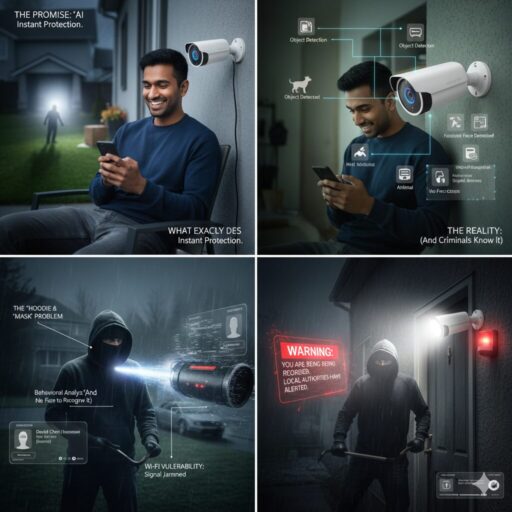
We’ve all seen the commercials: a homeowner, miles away, gets an alert, sees a would-be burglar on their phone, and scares them off with a two-way speaker. It looks simple. It looks effective.
But we’ve also experienced the reality of “smart” tech. How many times has your “person detected” alert turned out to be a stray cat, a wind-blown branch, or just a shadow?
This flood of false alarms creates a “boy who cried wolf” effect, causing us to ignore the very notifications designed to protect us. This brings up the million-dollar question for any property owner: Are AI security cameras truly a powerful deterrent, or just an expensive gadget that criminals have already learned to ignore?
Let’s break down what AI really does and whether it’s “smart” enough to protect what matters.
What Exactly Does “AI” Mean in a Security Camera?
First, let’s clear up the jargon. A standard motion-detection camera (a “dumb” camera) triggers an alert every time any pixel changes in its view. This could be rain, bugs, or headlights.
An AI-powered camera goes a crucial step further. It uses on-device or cloud-based processing to analyze and identify what it sees.
Object Detection: This is the most common feature. The AI is trained to differentiate between a Person, a Vehicle, an Animal, or just a Package. This alone cuts down on 90% of useless alerts.
Facial Recognition: More advanced systems can learn familiar faces. They can tell you if it’s your dog walker arriving or an “Unfamiliar Face” detected on your porch.
Behavioral Analysis: High-end AI can even learn patterns. It can flag “loitering” (someone lingering too long in one spot) or a “perimeter cross” (someone hopping your fence), which are much higher-threat indicators than simple motion.
The Good: How AI Gives You the Upper Hand
When implemented correctly, an AI security system is a massive leap forward. Its primary strength isn’t just recording—it’s notification and speed.
Massive Reduction in False Alarms: This is the #1 benefit. When your phone buzzes, you’re conditioned to take it seriously. You won’t ignore a “Person Detected at 3 AM” alert in the same way you’d ignore a “Motion Detected” alert.
Active & Automated Deterrence: Modern AI cameras don’t just watch; they act. When the AI positively identifies a person in a restricted area (like your backyard at night), it can automatically:
Trigger a blinding floodlight.
Sound a loud, built-in siren.
Issue an automated warning: “You are being recorded. This area is under surveillance.” A criminal who thought they were being stealthy is suddenly exposed. This is often enough to make them flee.
Actionable Information (Not Just Data): In the event of a break-in, you don’t have to scrub through 8 hours of footage. You can instantly filter your recordings. “Show me all ‘Person’ events between 2 AM and 4 AM.” Law enforcement gets a clear, usable timeline, not a digital haystack.
The Bad: Where AI Fails (And Criminals Know It)
AI is not “RoboCop.” It’s a powerful tool, but it has significant limitations that a savvy criminal can exploit.
The “Hoodie and Mask” Problem: Facial recognition is useless if there’s no face to recognize. Criminals are not new to this; they wear hoodies, masks, and hats. AI can still detect them as a “person,” but it can’t identify who they are.
Poor Lighting & Weather: Heavy rain, snow, or dense fog can “blind” an AI camera just as easily as a human eye. A cheap camera with “amazing AI” will still produce a grainy, useless image at night, making accurate identification impossible.
The Wi-Fi Vulnerability: Many consumer-grade AI cameras rely on your home Wi-Fi. A $50 Wi-Fi jammer, easily bought online, can knock your entire system offline, rendering the camera and its “smart” features useless.
They Can’t Physically Stop Anyone: This is the most critical point. A camera has never stopped a bullet, a crowbar, or a determined intruder. It’s a notification device, not a physical barrier.
So, Can an AI Camera Stop a Real Criminal?
The answer is a nuanced but clear Yes and No.
No, an AI camera, by itself, cannot physically stop a determined, professional criminal who has planned their attack, understands the technology, and is willing to use force or bypass methods.
But absolutely YES, an AI camera is extremely effective at stopping the vast majority of criminals: the opportunistic ones.
Most burglaries are not elaborate heists. They are crimes of opportunity. A potential thief looks for an easy target—a dark house, no visible security, and a clear escape route.
An AI security system turns an “easy target” into a “hard target.” When a criminal is met with:
A bright, obvious camera (deterrence).
Sudden, blinding floodlights (exposure).
A loud, automated siren (alarm).
…they are no longer in control. They don’t know who is watching, if police have been called, or if a security patrol is seconds away. In this scenario, the AI has effectively stopped the crime by making your property a high-risk, low-reward target.
AI Is Your Smartest Lookout, Not Your Bodyguard
Don’t buy an AI security camera thinking it’s an impenetrable force field. It’s not.
Think of it as the smartest, most reliable lookout you could ever hire. It never sleeps, it never gets distracted, and it knows exactly what to look for. Its job is to identify the threat instantly and sound the alarm so that a real response can be initiated—whether by you, a private security service, or law enforcement.
The “smart” in AI security isn’t about building a robot. It’s about giving you the one thing that matters most in a crisis: time. And in security, time is everything.
License plate recognition systems, as one of the cornerstones of modern security infrastructure, increase security and increase efficiency in operational processes. This AI-powered advanced technology that reduces staff costs delivers a transformation that redefines return on investment (ROI). In this content, we discussed the details about the license plate recognition system and its working principle.
The intersection of physical intrusion and digital theft presents one of the most complex challenges in modern security. Post-Breach Forensics in these blended incidents requires specialized expertise to reconstruct the timeline and scope of the damage. When a seemingly isolated physical break-in—such as stolen hardware or unauthorized access to a server room—results in a significant data exposure, the subsequent Post-Breach Forensics investigation must meticulously bridge the gap between tangible evidence and digital logs. Understanding this integrated process is essential for legal compliance, remediation, and preventing future convergence attacks.
Our home is not just a place where we reside, but also a special area where we keep our most valuable belongings and feel safe with our loved ones. However, increasing theft cases and cyber threats make home security more important than ever. In this article, you will find 20 practical tips you can implement to protect your home and loved ones. These tips cover a wide range, from traditional methods to smart home technologies, from personal security measures to cybersecurity strategies. Remember, taking proactive home security measures is the most effective way to minimize potential risks. The FBI’s crime statistics emphasize the importance of investing in home security.
In a sprawling metropolis like Los Angeles, relying solely on passive security measures is no longer adequate. The true effectiveness of a security strategy goes fundamentally beyond the alarm, requiring a proactive, immediate, and intelligent human presence. Onsite security guards provide the dynamic response, deterrence, and de-escalation skills that automated systems simply cannot replicate. For high-value commercial properties, residential communities, and corporate facilities in LA, a uniformed guard service is the essential bridge between a potential threat and a controlled resolution.
Face recognition authentication systems are revolutionizing the landscape of modern security and operational efficiency. By leveraging fast, contactless, and reliable biometric data, facial recognition technology not only modernizes institutional access control but also significantly streamlines business workflows. This advanced technology stands out by offering a seamless balance between robust protection and user convenience.