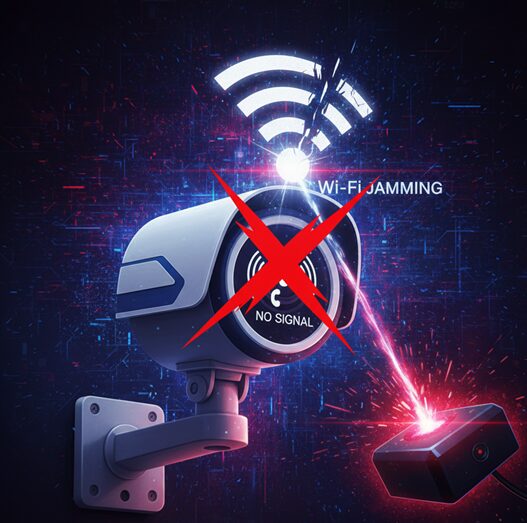
Wi-Fi Jamming Attack – Why Your Wireless Security Cameras Might Be Useless During a Break-In
In the age of smart homes, wireless security cameras offer peace of mind. They are easy to install, affordable, and promise constant vigilance. But what happens when the very technology they rely on—Wi-Fi—becomes their greatest weakness? Sophisticated criminals are increasingly utilizing readily available technology to execute what is known as a Wi-Fi Jamming Attack. This simple yet devastating technique can render your high-tech security system instantly blind and deaf, turning your smart home into an unprotected target.
This article explores the technical mechanisms behind Wi-Fi Jamming Attacks, reveals why your wireless cameras are uniquely vulnerable, and provides practical defense strategies to ensure your security system remains functional when you need it most.
The Threat Defined: What Are Wi-Fi Jamming Attacks?
A Wi-Fi Jamming Attack is essentially a highly localized, directed Denial-of-Service (DoS) attack. Its goal is not to hack or steal data, but simply to overwhelm the radio frequencies used for communication.
Most home security devices and Wi-Fi networks operate on the 2.4 GHz and 5 GHz unlicensed radio bands. A jamming device, often nothing more complex than a small, portable radio transmitter, broadcasts powerful noise signals across these specific frequencies.
The effect is immediate: the massive interference drowns out the legitimate, weaker signals from your cameras and routers. To your devices, it’s like trying to have a conversation in front of a jet engine—they cannot hear the network, and the network cannot hear them. This targeted electronic assault is the fundamental mechanism of all Wi-Fi Jamming Attacks.
Why Jamming Attacks Silence Your Cameras
The inherent design of wireless security cameras makes them acutely susceptible to Wi-Fi Jamming Attacks.
Dependency on a Single Link
Wireless cameras are designed for convenience. They rely entirely on a single Wi-Fi connection to send data to your local network and, crucially, to the cloud. If that single link is broken, the camera ceases to function as a security device. It cannot:
During a Wi-Fi Jamming Attack, this single link is severed. The camera may continue to record to a local SD card (if it has one), but you, the homeowner, will receive zero warning that an intrusion is occurring. For the criminal, the success of the Wi-Fi Jamming Attack translates directly into an uninterrupted entry.
Frequency Specificity
The simplicity of launching Wi-Fi Jamming Attacks is frightening. Criminals don’t need to be master hackers; they only need to buy a cheap, illegal jammer device configured to target the specific frequencies used by standard Wi-Fi protocols (802.11 standards). Since all standard consumer cameras use these bands, a single jammer can incapacitate the entire security system of a home or small business simultaneously.
The Attacker’s Playbook: Implementing Wi-Fi Jamming Attacks
The Rise of AI Vishing shows criminals using advanced tech, but the simplicity of Wi-Fi Jamming Attacks makes them a favored tool for break-ins. The process is straightforward:
This strategy leverages the most common point of failure: the reliance on an always-on wireless signal.
How to Defend Against Wi-Fi Jamming Attacks
While the threat is serious, there are several effective strategies to harden your security system against Wi-Fi Jamming Attacks.
1. Integrate Wired and Wireless Systems
The most reliable countermeasure is redundancy. Wired security systems (Power over Ethernet, or PoE) are completely immune to Wi-Fi Jamming Attacks because they transmit data via a physical Ethernet cable, not radio waves.
2. Physical System Hardening
If the jammer can’t get close to the security equipment, the attack is less effective.
3. Consider Cellular or Landline Backups
Your home alarm panel (distinct from your cameras) should have a backup method for sending alerts to the monitoring company.
4. Utilize Non-Standard Frequencies
Some high-end security systems use proprietary wireless frequencies (e.g., Z-Wave or specialized frequency-hopping spread spectrum protocols) for their internal sensors and communications. These are far more difficult for a standard Wi-Fi jammer to target effectively.
5. Immediate “Offline” Alerts
If a professional monitoring service is used, they should be configured to immediately alert you if a camera or sensor suddenly reports as “offline” for an unexplained reason. While this doesn’t prevent the jam, it speeds up response time. The convenience of wireless technology has inadvertently created a new, critical vulnerability in home security. The simplicity and effectiveness of Wi-Fi Jamming Attacks mean that relying solely on wireless cameras for protection is a risk that is no longer acceptable.
By understanding that a Wi-Fi Jamming Attack is a Denial-of-Service problem, not a hacking problem, you can take effective defensive measures. Integrating wired connections and creating communication redundancy are the essential steps to ensure that your security system stands strong, even when the airwaves are silent.