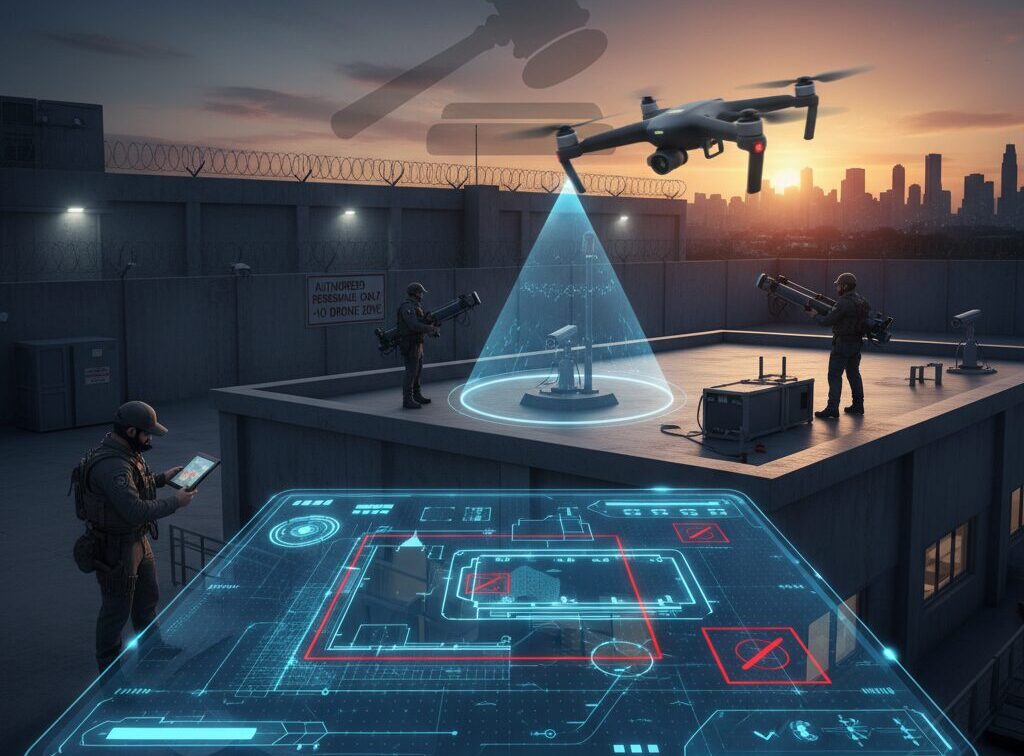
Drone Defense 101: How to Legally Protect Your Facility from Aerial Spying

Drone Defense 101 – How to Legally Protect Your Facility from Aerial Spying

The proliferation of affordable and sophisticated drones has introduced a challenging new vector for corporate espionage, unauthorized surveillance, and physical security threats. For facilities housing sensitive data, critical infrastructure, or high-value assets, passive security measures are no longer sufficient. Establishing robust drone defense protocols is paramount, but must be done within strict legal boundaries. This guide explores the essential components of a legal and effective drone defense strategy designed to safeguard your facility from aerial intrusion and spying.


The Unseen Threat – Why Traditional Security Fails

Traditional security measures—fences, guards, and CCTV—focus on ground-level threats. However, drones bypass these entirely, providing intruders with unprecedented access to:

  • Aerial Surveillance: Capturing high-resolution photos and video of proprietary processes, manufacturing layouts, or sensitive personnel movements.
  • Contraband Delivery: Used to drop off small items, including recording devices or unauthorized packages, directly onto a property.
  • Vulnerability Mapping: Identifying blind spots in security systems for future ground-based attacks.

This makes implementing proactive and legal drone defense systems a critical necessity for modern security portfolios.


Legal and Ethical Drone Defense Measures

The most significant challenge in drone defense is the legality. In many jurisdictions, firing at, jamming, or otherwise physically damaging a drone is illegal and can result in severe penalties. Therefore, legal drone defense focuses on detection, tracking, and non-kinetic mitigation:

Detection and Tracking Systems

The foundation of effective drone defense is knowing they are there. This involves using:

  • RF (Radio Frequency) Sensors: These systems passively listen for the specific radio frequencies used by commercial drone controllers, identifying the drone’s model and location.
  • Radar and Acoustic Sensors: Used to detect non-RF-emitting drones or systems flying autonomously.
  • Integrated Monitoring: All sensor data must feed into a single pane of glass (like a PSIM system) to give security teams a real-time, comprehensive view of the aerial threat.

Non-Kinetic Mitigation Strategies

Once a drone is confirmed and tracked, legal drone defense requires non-destructive countermeasures:

  • Geofencing (Soft Mitigation): Working with drone manufacturers (like DJI) to program the coordinates of your sensitive facility into their firmware, preventing the drones from being flown into the area. This requires proactive registration and communication.
  • Protocol Activation: Instead of attempting to take down the drone, security protocols should focus on protecting assets. This includes immediately covering sensitive equipment, sheltering key personnel, and moving operations indoors.
  • Legal Reporting and Documentation: Documenting every unauthorized flight, including location, time, and trajectory, is crucial for filing reports with aviation authorities and establishing a legal basis for future action.

The Future of Drone Defense

As the technology evolves, the focus of drone defense will remain on detection and responsible mitigation. Organizations should view drones not just as an external threat, but as a compliance challenge. Integrating advanced detection technology with strict internal protocols ensures that your facility maintains a high level of security without breaching aviation laws. Investing in drone defense is investing in the long-term integrity of your operations. Is your facility vulnerable to aerial spying? Our 101 guide covers the legal C-UAS drone defense strategies you must know to protect your assets without breaking the law.

That faint buzzing sound overhead is no longer just a hobbyist’s toy. For facility managers, security directors, and business owners, it’s the sound of a modern, asymmetric threat. Unmanned Aircraft Systems (UAS), or drones, have become a cheap, easily accessible tool for corporate espionage, privacy invasion, and illicit surveillance. From a competitor trying to steal trade secrets from your R&D facility to activists mapping your critical infrastructure, the threat is real. But here’s the problem: your first instinct—to “deal with” the drone—is probably illegal. Jamming it, catching it, and especially shooting it down, can land you in a sea of legal trouble with the FAA and FCC, facing massive fines and potential criminal charges. So, how do you protect your airspace without becoming a criminal yourself? This is your essential guide to legal drone defense.


The Sky-High Risk – Why Drones Are a Facility’s Nightmare

Before we get to the solution, let’s define the problem. A $500 drone can bypass your multi-million dollar perimeter security (fences, guards, and access control) with ease.

The risks include:

  • Corporate Espionage: Competitors can use high-resolution cameras to photograph sensitive prototypes, monitor shipping schedules, or identify key personnel.
  • Privacy & Harassment: Prying eyes can peer into executive offices or film employees, leading to harassment claims and a loss of privacy.
  • Data Theft: Advanced drones can be equipped to perform “fly-by” cyber-attacks, sniffing Wi-Fi networks or spoofing cell signals to steal credentials.
  • Physical Threat: While less common for spying, drones can be modified to carry small, harmful payloads or disrupt operations (e.g., flying into an HVAC intake).

The Red Zone – What You CANNOT Legally Do

This is the most critical section of this article. Taking the “Wild West” approach to drone defense will backfire. In the UnitedS, the skies are the jurisdiction of the Federal Aviation Administration (FAA), and the airwaves are controlled by the Federal Communications Commission (FCC).

Under federal law, you are prohibited from:

  • Shooting It Down: This is a federal crime. Destroying an aircraft, even an unmanned one, can lead to severe penalties, including prison time (18 U.S.C. § 32).
  • Jamming (RF Jamming): Using a device to block the drone’s control or GPS signal is a direct violation of the Communications Act of 1934. The FCC imposes enormous fines (up to $100,000 or more) for jamming, as it can interfere with critical signals, including air traffic control and 911 calls.
  • Spoofing: This involves feeding false GPS signals to hijack the drone. Like jamming, this is illegal and highly regulated.
  • Physical Capture (Nets): While less clear-cut, physically capturing a drone that doesn’t pose an immediate physical threat can be considered theft or destruction of property.

The Legal Playbook – A 4-D Strategy for Drone Defense

Your defense strategy shouldn’t be a single “magic bullet” (which is illegal anyway). It must be a layered, professional security approach. We call it the 4-D Strategy.

Detect – You Can’t Stop What You Can’t See

The foundation of any legal C-UAS (Counter-UAS) plan is detection. If your only detection method is a guard spotting a tiny drone in the sky, you’ve already lost.

Modern drone detection systems use a layered approach, often combining:

  • RF (Radio Frequency) Analysis: These are the most popular systems. They “listen” for the electronic chatter between the drone and its controller, identifying the drone’s make, model, and often the controller’s precise location.
  • Radar: Small, specialized radars can track the physical movement of small objects, even if they are “radio silent” (i.e., flying a pre-programmed mission).
  • Acoustic Sensors: Microphones that listen for the unique sound signature of drone propellers. Best for quiet, rural areas.
  • Optical (Cameras): AI-powered cameras that can spot and automatically track a drone, distinguishing it from a bird.

Pro-Tip: A good detection system is your best investment. It provides early warning, which is the currency of all security.

Document – Build Your Legal Case

Once your system detects a drone, your team’s next job is to become expert witnesses. You must document everything. This data is what you will use to engage law enforcement.

  • Log Everything: Time, date, and duration of the intrusion.
  • Track the Flight Path: Show a map of where the drone flew over your property. Did it hover over sensitive areas?
  • Get Photos/Video: Use your own security cameras to get visual evidence of the drone and, if possible, the operator.
  • Identify the Operator: If your RF system detects the operator’s location (e.g., in a car parked down the street), do not confront them. Instead, guide law enforcement to their location.

Deter – The “Passive” Defense

Deterrence is about making your facility a less attractive target.

  • “Hardening” Your Facility: This is the most effective passive defense. If a drone can’t see anything sensitive, its value as a spying tool plummets.
  • Use privacy films on executive or R&D windows.
  • Keep sensitive materials and prototypes covered or indoors.
  • Erect visual barriers or privacy screens on rooftops or in outdoor test areas.
  • Signage: Post clear, professional signage around your perimeter: “Private Property – No Drone Flyovers Permitted. All UAS Activity is Monitored and Reported to Law Enforcement.” This establishes legal intent and may deter casual operators.
  • Secure Your Network: Harden your facility’s Wi-Fi network to prevent data-sniffing attempts from the air.

Defend – The “Active” (and Legal) Response

This is the “defend” phase, and it’s all about policy and procedure. When a drone is detected and documented:

  • Call Local Law Enforcement: This should be your primary action.
  • While the FAA controls the airspace, the drone operator is standing on the ground. They are likely committing local crimes like trespassing (if on your land), harassment, or violating local ordinances.
  • Provide them with your “documentation” package: “We have a drone flying over our secure data center at 100ft, and the operator is located in a blue Toyota at the corner of 1st and Main.” This is the kind of actionable intelligence police can respond to.
  • Report to the FAA: If the drone is being flown in a clearly unsafe or reckless manner (e.g., near other aircraft, over dense crowds, or interfering with your facility’s own aviation), file a report with the FAA.
  • Consult Legal Counsel: Have a lawyer who specializes in drone and privacy law review your C-UAS policy. They can help you understand your rights and the specific local laws in your state.

The Future: Authorized C-UAS Systems and the New Era of Airspace Security

The law is slowly catching up to the technology. The FAA is in the process of creating rules and certifications for “authorized” C-UAS systems that can legally mitigate drone threats, but as of today, these are almost exclusively reserved for federal entities and critical infrastructure like airports and power plants. For the rest of the market, detection and reporting remain the only safe and legal strategies.

The rapid proliferation of Unmanned Aerial Systems (UAS), or drones, has created both immense opportunities and significant security challenges. In response, the demand for effective Counter-Unmanned Aerial Systems (C-UAS Systems) has surged, driving innovation in authorized defensive technologies. Understanding and implementing robust C-UAS Systems is no longer optional; it is a critical component of modern defense and national security strategies.

The Imperative for Advanced C-UAS Systems

Drones pose a clear and present danger to critical infrastructure, public safety, and military operations. From state-level surveillance to unauthorized incursions by small, commercially available UAS, the threat vector is diverse and continually evolving. This necessitates the adoption of advanced, integrated C-UAS Systems that can detect, track, identify, and ultimately mitigate hostile or unauthorized drones.

Key Technologies within C-UAS Systems

A truly effective C-UAS Systems solution is a layered defense incorporating multiple technologies working in concert.

  • Detection and Tracking: The first step for any C-UAS Systems is early and accurate detection. This typically involves a combination of:
  • Radar Systems: Specialized low-altitude, small-target radars are essential for tracking multiple UAS simultaneously.
  • RF (Radio Frequency) Sensors: These passively detect and classify drones by analyzing the unique radio signals exchanged between the drone and its controller. RF detection is often the first line of defense in modern C-UAS Systems.
  • Electro-Optical/Infrared (EO/IR) Cameras: Used for positive visual identification and tracking, especially in environments with high radar clutter.
  • Identification and Classification: Once detected, the C-UAS Systems must quickly determine if the UAS is a threat. This relies on sophisticated algorithms and comprehensive drone databases to classify the drone type and assess its intent.
  • Interdiction/Mitigation: This is the action phase of the C-UAS Systems. Mitigation methods vary based on the threat level, operational environment, and legal authorization:
  • Soft Kill Measures: These include electronic warfare (EW) techniques, such as GPS spoofing or jamming the command and control (C2) links, forcing the drone to land or return home. Many authorized C-UAS Systems prefer this non-kinetic approach to avoid collateral damage.
  • Hard Kill Measures: For high-threat scenarios, kinetic measures like net-guns, specialized ammunition, or even high-energy lasers may be authorized.

Legal and Regulatory Challenges for C-UAS Systems

The deployment of C-UAS Systems operates within a complex legal and regulatory landscape. Strict authorization is mandatory, particularly concerning the use of electronic countermeasures that could interfere with legitimate airspace operations, such as commercial aviation or emergency services. The future of C-UAS Systems hinges on developing technologies that are highly precise and narrowly focused, minimizing the risk of unintended consequences. Governments and regulatory bodies are continually updating laws to enable authorized entities (military, police, critical infrastructure operators) to legally deploy and operate their C-UAS Systems.

The Future of C-UAS Systems – Integration and AI

The next generation of C-UAS Systems will be defined by greater integration and the heavy use of Artificial Intelligence (AI).

  • AI-Powered Autonomy: AI will enable C-UAS Systems to autonomously detect, classify, and even recommend or execute mitigation strategies faster than human operators.
  • System Integration: Future C-UAS Systems will be seamlessly integrated into existing air traffic management (ATM) and command, control, communications, computers, and intelligence (C4I) networks, creating a unified picture of the airspace.
  • Swarm Defense: As drones are increasingly deployed in swarms, C-UAS Systems are evolving to handle coordinated, multi-target threats using networked mitigation assets.

The evolution of C-UAS Systems is a critical security race. As unauthorized UAS capabilities advance, authorized C-UAS Systems must stay ahead through continuous technological innovation and clear regulatory frameworks. The security of our airspace depends on these cutting-edge C-UAS Systems.

Bottom Line – Get Smart, Not Aggressive

The drone threat is real, but the legal and financial risk of taking matters into your own hands is even greater.

A successful drone defense plan for your facility isn’t about high-tech-weapons. It’s about a smart, layered security posture.

  • Invest in a reliable detection system.
  • Train your staff to document intrusions.
  • Harden your facility to deter prying eyes.
  • Create a policy to defend your assets by notifying law enforcement.

This professional approach protects your assets, limits your liability, and keeps your facility secure—on the ground and in the air.

Similar Posts

  • Data Breach Prevention Strategies

    Data Breach Prevention Strategies: A Comprehensive Guide for Beginners In today’s interconnected world, data breaches are a constant threat to…

  • Smart Home Security Vulnerabilities

    The modern dream of a connected, automated home brings unprecedented convenience. Yet, it also unlocks a dangerous door to complex digital risks. Understanding Smart Home Security Vulnerabilities is the absolute first step in protecting your private sanctuary. It is no longer just about convenience; it is about defending your digital perimeter.

  • The Best Identity Theft Protection of 2025 – Your Ultimate Guide to Staying Safe

    Navigating the digital landscape in 2025 requires more than just strong passwords; it demands proactive defense against increasingly sophisticated cybercriminals. Finding The Best Identity Theft Protection service is no longer a luxury—it’s a necessity for safeguarding your financial health, credit score, and personal reputation. As data breaches become more common and AI-driven scams proliferate, understanding the features that truly define The Best Identity Theft Protection is crucial for maintaining peace of mind.

  • The Rise of AI Vishing – How to Spot a Deepfake Call Before You Lose Money

    In the digital age, we have been conditioned to mistrust suspicious emails and unsolicited text messages. But what happens when the threat comes from the most trusted source of all: a familiar voice on the telephone?

    The Rise of AI Vishing marks a terrifying new chapter in cybercrime. Vishing, or Voice Phishing, used to rely on generic, robotic calls. Now, powered by generative AI, scammers can clone the voices of your loved ones, your boss, or your bank manager with startling accuracy.

    This shift has created a high-stakes vulnerability for individuals and businesses worldwide. Understanding the technology behind deepfake audio is the critical first step in protecting your money. This extensive guide will explore the mechanics fueling the Rise of AI Vishing, expose the common tactics used by attackers, and provide essential, actionable steps to help you spot a fake call before you fall victim.

  • The True Cost of “Checking the Box” on Cybersecurity Compliance

    While Cybersecurity Compliance is a regulatory necessity, viewing it as the ultimate objective is a strategic failure. Relegating compliance to a purely administrative function creates a misalignment between perceived safety and actual risk posture. This “compliance-first” mentality fosters a false sense of security, leaving critical vulnerabilities within the defense architecture unaddressed. Furthermore, it results in significant budgetary inefficiency. For the modern CISO, distinguishing between regulatory adherence and genuine security resilience is paramount to avoiding the hidden costs of superficial compliance.

  • Docker Installation and Usage Example

    Cybersecurity if you work in the field, you need to have a very wide range of deep knowledge as well as constantly continue your development. Last year, if you followed software development trends Dockeryou may have heard of ‘a lot. DevOps you may notice that developers working in the field talk about containers, isolated machines, hypervisors, and they often talk about them. Here in this article is one of the above statements, “Why we need containers“, we’ll talk about that.