Shield Your Privacy – Top Expert Tips to Block Website Trackers
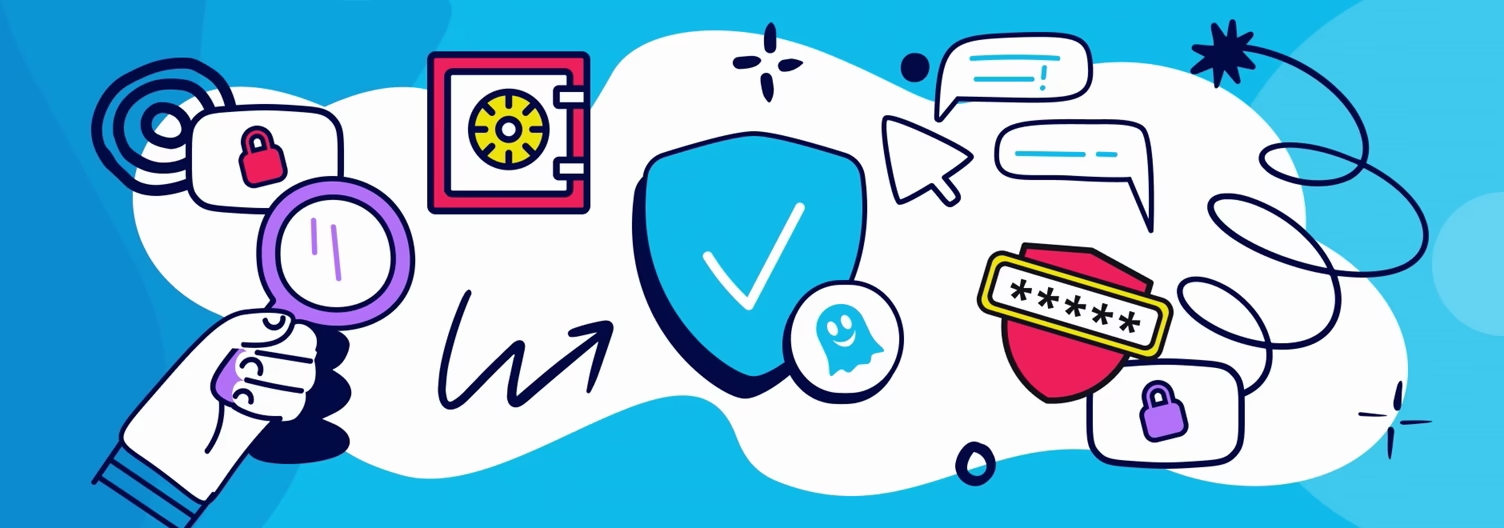
Block Website Trackers – Ever feel like someone’s watching your every move online? That’s because they might be. Every click, search, and late-night browsing session can be tracked, analyzed, and even sold. But don’t worry, you can take back control. This guide will show you how to block online trackers, fly under their radar, and reclaim your privacy.
Block Website Trackers – Understanding How Websites Track You
Ever wonder how the internet seems to know you better than you know yourself? That’s because it’s tracking you right now. Every scroll, click, and second spent on a page is recorded, analyzed, and monetized. Let’s expose these tracking tactics.
The Many Faces of Online Tracking
Why Websites Track You
Essential Steps to Minimize Website Tracking
The internet wants to track you, but you can become a ghost. No more breadcrumbs, no more trackers leeching off your data. Let’s fortify your digital defenses.
Adjusting Your Browser Settings
Choosing a Privacy-Focused Browser
Tools & Extensions to Block Trackers
The internet is rigged against you, but you can fight back. Here are some tools and extensions to help you block trackers and reclaim your privacy.
Browser Extensions That Silence the Spies
For more information on privacy tools, you can visit the Electronic Frontier Foundation.
Imagine This: No More Geo-Restrictions or Buffering
You click play, and nothing happens. A black screen stares back at you with an error message. The channel you want is locked away behind geo-restrictions. You refresh, but the stream stutters, pixelates, and buffers endlessly. Your ISP is throttling your connection, punishing you for using too much bandwidth. Meanwhile, in a cold, fluorescent-lit data center, your viewing history is logged, tagged, and stored. Today, we’ll guide you through how to protect your online privacy and keep hackers and trackers at bay.
The Harsh Reality: Why You Need a VPN for IPTV
IPTV should be simple. You fire it up, and you stream. End of story. But that’s not how it works anymore.
Geo-blocks strangle your access
You paid for a subscription, so why is half the content locked behind invisible borders?
Your ISP is watching
Ever wondered why your stream runs fine one minute and turns into a buffering mess the next? They see what you’re doing, and they don’t like it.
Your data is wide open
Every click, every stream, every request leaves a footprint—one that ISPs, governments, and advertisers feed on.
You’re not just streaming; you’re being watched. A real VPN doesn’t just unlock IPTV; it erases your digital trail. No slowdowns, no surveillance, no restrictions. It’s either freedom or control. Which side are you on?
How VPNs Break Through Blocks and Make You Invisible
A proper VPN is not just a tool; it’s a weapon.
IP Masking
You disappear. Your real location is replaced, and now you’re anywhere you need to be.
Encryption
Your data travels through a tunnel so tight and secure that not even your ISP can peek inside.
Anti-Throttling Technology
ISPs can’t slow what they can’t detect. You just went from lagging to light-speed.
Obfuscation Mode
Some IPTV services try to block VPNs. The best VPNs block them right back.
Smart DNS Bypass
When firewalls get aggressive, Smart DNS gets smarter.
No trace. No slowdown. No limits.
What Separates a “VPN” From a True IPTV Unblocker?
Most VPNs are garbage.
Slow
What’s the point of unblocking IPTV if it turns into a pixelated slideshow?
Banned
Many VPNs crumble the second a platform sniffs them out. Error messages everywhere.
Logging Your Data
The ultimate betrayal—a VPN that sells your history instead of hiding it.
You need a VPN that can take a hit and come back swinging. Here’s what separates the real ones from the fakes:
Massive Global Server Network
More servers equal more ways around restrictions.
Blazing Fast Speeds
The difference between buttery smooth 4K and watching a slideshow.
Top-Tier Security
AES-256 encryption, kill switch, no-logs policy. If your VPN isn’t airtight, what’s the point?
Bypass Detection
VPN bans? Obfuscation mode. Throttling? ISP invisibility cloak. This is next-level tech.
Device Compatibility
IPTV is everywhere—your VPN should be too. Smart TVs, Firestick, Android TV, iOS, routers.
Pick wrong, and you’re back to buffering. Pick right, and you’re unstoppable.
The VPNs That Actually Work
We stress-tested every VPN. Most failed. The few that made the cut are right here.
ExpressVPN (Best Overall)
The fastest, most consistent VPN. No lag, no detection, no compromises. Servers in 94 countries, Smart DNS, MediaStreamer, AES-256 encryption, no-logs policy. Best for IPTV users who want flawless performance.
NordVPN (Most Secure)
Advanced encryption and obfuscated servers that hide VPN traffic completely. Servers in 60 countries, CyberSec ad blocker, Onion Over VPN, double encryption. Best for those who value absolute privacy.
Surfshark (Best Budget VPN)
Unlimited device connections for one low price. Perfect for families. Servers in 100 countries, CleanWeb ad blocker, Camouflage Mode, Smart DNS. Best for multiple devices, one subscription.
CyberGhost (Best for Beginners)
IPTV-optimized servers, zero setup headaches. Servers in 91 countries, automatic kill switch, streaming-optimized servers. Best for first-time VPN users.
Private Internet Access (PIA) (Most Customizable)
Ultra-configurable encryption for advanced users. Servers in 84 countries, OpenVPN & WireGuard, port forwarding, split tunneling. Best for tech-savvy users who want full control.
No fluff. No gimmicks. Just the VPNs that work.
How to Set Up a VPN for IPTV
Setting up a VPN isn’t just a checkbox. Do it right, and IPTV flows like liquid. Do it wrong, and you’re back to lag, blocks, and frustration. Here’s how to nail it.
Step 1: Pick a VPN That Can Take a Hit
Not all VPNs are cut out for IPTV. Some are too slow. Others get detected and shut down. If you haven’t chosen one yet, go back—ExpressVPN, NordVPN, and Surfshark are your top picks.
Step 2: Install It on Your Streaming Device
Every device has different rules. Here’s how to break them.
Step 3: Choose the Right Server (Or Regret It)
- Need to bypass geo-blocks? Connect to a server where the IPTV content is unlocked.
- ISP throttling you? Pick a nearby, high-speed server.
- VPN not working? Use obfuscated servers (NordVPN) or Smart DNS mode.
Step 4: Activate Your Streaming Arsenal
Step 5: Hit Play
No buffering. No blocks. No limits.
How CCPA is Reshaping Data Privacy Across the U.S. – What You Need to Know
Following the European Union’s implementation of the General Data Protection Regulation (GDPR) in 2018, California took a bold step by introducing similar legislation in the United States. The California Consumer Privacy Act (CCPA), which came into effect on January 1, 2020, is designed to protect the privacy rights of California residents. The CCPA gives consumers significant rights regarding the access, deletion, and sharing of their personal information collected by businesses. But the influence of this regulation isn’t limited to California. States like Washington, Colorado, New York, and Massachusetts are now developing their own privacy laws inspired by the CCPA.
Understanding the Key CCPA Requirements
The CCPA requires businesses to comply with several important mandates:
According to David Oberly, an associate at a respected U.S. law firm, ‘The CCPA is the first of a coming tsunami of state-level privacy laws which, together, will radically shift how businesses collect, use, and protect personal data.’
Other States Joining the Privacy Movement
At the end of 2019, Nevada quickly passed Senate Bill 220, which amended their existing online privacy laws. Effective from October 2019, this bill allows consumers to opt out of the sale of their personal data, similar to the CCPA.
Nevada and California are leading the way in online privacy regulations, but many other states are not far behind:
New York and Massachusetts are the next states likely to introduce CCPA-like legislation. Over the next few years, it is expected that all states will follow suit and pass bills to protect consumer privacy. If these issues are not addressed at the state level, the federal government may step in to establish nationwide privacy requirements for businesses.
Stay Informed and Take Action
If you found this article helpful, please share it with a friend who might need to better protect themselves. Stay informed and subscribe to our newsletter for regular updates on cybersecurity. Follow us on social media for more insights and consider signing up for a free trial of our cybersecurity training programs.
CISA Warns – New Mobile Spyware Threatening Your Privacy
The Cybersecurity and Infrastructure Security Agency (CISA) has issued a critical alert that demands immediate attention from organizations worldwide. Sophisticated spyware is being actively deployed by threat groups, targeting popular messaging apps on both iOS and Android devices. The primary goal of these cyber threats is to steal private conversations, track user movements, and extract sensitive data directly from mobile devices.
Active Attacks on Messaging Apps
Recent campaigns have been particularly focused on high-value targets in the UAE, including journalists, dissidents, and government workers. However, this threat is not confined to any single region. Organizations globally that possess intellectual property, financial data, or critical infrastructure are at significant risk.
What Makes This Spyware So Dangerous?
Unlike conventional malware that can be easily detected by antivirus software, this spyware is highly sophisticated, stealthy, and specifically designed to target messaging apps. These apps are the platforms where modern business communications occur, making them prime targets for cyber threats. Here are some of the activities that take place on these platforms:
Companies rely on apps like Slack, WhatsApp, Signal, Telegram, Messenger, WeChat, and SMS for business communications. Compromising these channels can lead to the compromise of the entire organization.
Capabilities That Should Worry You
According to CISA, this spyware can perform a range of malicious activities, including:
This is commercial-grade surveillance technology designed for persistence and stealth, making it a significant threat to both individuals and organizations.
How Spyware Infections Occur
CISA identifies several common infection vectors for this spyware, including:
It’s important to note that users don’t always need to click on a suspicious link to become infected. However, most installations still require users to install apps from outside Android and Apple’s official stores, which should be a red flag for security-trained individuals.
Why Messaging Apps Are Prime Targets
Messaging apps have become the ultimate attack surface because they are:
Mobile devices are now primary endpoints, yet most companies still treat mobile security as optional, which needs to change.
How Organizations Can Protect Themselves from Spyware
To safeguard against these threats, organizations should implement the following measures:
Responding to Suspected Spyware Infections
If you suspect a device is compromised, follow this protocol:
Remember, mobile spyware is designed for persistence. Simply uninstalling an app will not remove it.
The Bigger Picture: Mobile as Primary Attack Vector
CISA’s alert underscores a critical reality: mobile devices are now targeted entry points into corporate environments. Spyware is cheap, effective, stealthy, and specifically engineered to target the apps businesses depend on most. If your security strategy still centers on laptops, firewalls, and email scanning, you’re already falling behind. Mobile security isn’t optional infrastructure; it’s the foundation of Zero Trust security in a remote-first world.
Final Takeaway
CISA’s warning is direct and clear: spyware targeting messaging apps is not theoretical. It’s active, spreading, and effective. While recent attacks have focused on high-value individuals in the UAE, it’s only a matter of time before similar campaigns target businesses worldwide. Organizations that fail to harden their mobile security posture will find threat actors doing it for them, on the attackers’ terms. The time to act is now.