Cyber Security Measures to be Taken in the Office
Cyber Security Measures – Good cybersecurity is key to reducing the risk of cyber attacks in your business, and its main purpose is to protect your devices, the services you access with those devices, and the important information stored on those devices.
Cybersecurity is especially important in office environments to protect sensitive data and intellectual property, ensure business continuity, comply with regulations and maintain customer trust. It protects businesses from costly data breaches, reputational damage and operational disruptions by implementing technical, administrative and physical security measures.
What is Cyber Security and Why is it Critical?
Cybersecurity includes all measures taken to protect a business’s vital systems and information from any unauthorized use or access. Cybersecurity is also called information technology (IT) security and protects businesses from both internal and external threats.
Comprehensive cybersecurity practices include multi-layered protection mechanisms that cover all areas of business activities. An effective cybersecurity program must provide a strong defense against any cyber threats, including those that attempt to gain unauthorized access, capture or disrupt customer and employee data.
The average cost of a data breach in the USA in 2023 was recorded as 4.45 million dollars. Therefore, businesses should treat cybersecurity as a critical risk management element rather than an IT issue. Because the cost of negligence is extremely high. Both internal and external cybersecurity threats affect businesses of all sizes. Because security standards are more difficult to implement, especially in non-traditional work environments, these risks are increasing as companies turn to cloud computing and remote working models.
Hackers are constantly developing new methods to infiltrate systems and applications. Therefore, in the face of an evolving threat landscape, cybersecurity must be a continuous process that must be regularly reviewed and updated. Without strong cybersecurity protocols, businesses using the internet or cloud-based technologies put themselves at serious risk.
Additionally, customers expect their personal data to be stored securely and used for business purposes only when they use a business’s services. When this expectation is disrupted by a security breach, it is extremely difficult to regain trust. Nowadays, protecting a company from the possible consequences of cybersecurity attacks has become more critical than ever.
What is Office Security and What Does It Cover?
Office security; It refers to the protection of data, information, ideas and systems. Although these assets are not tangible, they are vital to the success and integrity of your business.
An effective office security strategy should protect your business’s critical data and information against hackers and other cybersecurity threats. It should also help you comply with current laws and regulations in your country or region.
Since 82’% of data breaches involve information stored in cloud environments, it is of great importance for businesses to securely protect their data in multiple environments.
Digital Threats in Modern Office Environments
While modern offices offer many advantages with the increase in digitalization, they have also become vulnerable to cyber threats. Although computers, smartphones, cloud systems and IoT devices facilitate business processes, digital threats pose risks to occupational safety and efficiency.
Phishing and social engineering attacks: In a recent IDC survey, 52’% of respondents said trusting employees to keep corporate resources and data safe was their biggest corporate concern. Phishing remains one of the most common threats, especially as employees access enterprise systems from multiple entry points such as personal devices or unsecured networks. Hackers use email, messaging apps, and even voice calls to direct users to disclose sensitive information or install malware. The most important thing businesses can do to prevent social engineering attacks is to organize regular security awareness training. By promoting the “Zero trust” mindset, businesses can help employees recognize phishing attempts and learn to verify unexpected communications. Also advanced e-mail filtering and anti-phishing tools are also useful in terms of security measures.
Unsafe endpoints: Endpoint security is becoming a major concern as employees use a combination of personal and corporate devices. Unpatched software, outdated antivirus programs, and lack of encryption can expose sensitive data to cyber attacks. Using endpoint detection and response (EDR) solutions helps secure your hybrid network and ensure the integrity of your data. When it comes to devices, you need to enforce compliance policies and use regular patch management. As an additional layer, using mobile device management (MDM) tools also closes all gaps for end-to-end security.
Weak identity and access management (IAM): The last thing businesses want is a data breach due to an incomplete update or an outdated device. Therefore, in hybrid work environments, it is of great importance that only authorized users and devices whose security is monitored can access corporate resources. Poor passwords, shared credentials, and lack of multi-factor authentication (MFA) seriously increase the risk of unauthorized access and security breaches. It is necessary to implement strong password policies and make MFA mandatory in all systems and business units. Single sign-on (SSO) solutions make authentication processes both more secure and more user-friendly. For highly sensitive data, role-based access controls (RBAC) should be implemented to limit access to only certain user groups or administrator levels.
Shadow IT: Shadow IT is another way hybrid workers unknowingly create security blind spots. For example, if an employee encounters a new AI tool to increase productivity and decides to try it, it could cause a malicious person to infiltrate the network. There are also shadow applications that can be downloaded unconsciously. It is crucial to conduct regular audits to detect and manage shadow IT. So make sure employees are informed about the risks of using unapproved tools and software and offer approved alternatives that meet their productivity and security needs. When you provide your employees with the right tools, you can greatly reduce their chances of solving problems on their own and uncontrollably.
Relationship between Data Security and Customer Trust
Customer trust can be quickly shaken by a cybersecurity breach. When businesses fail to protect their data, the consequences extend beyond breach. A cybersecurity incident can destroy customer trust in the following ways:
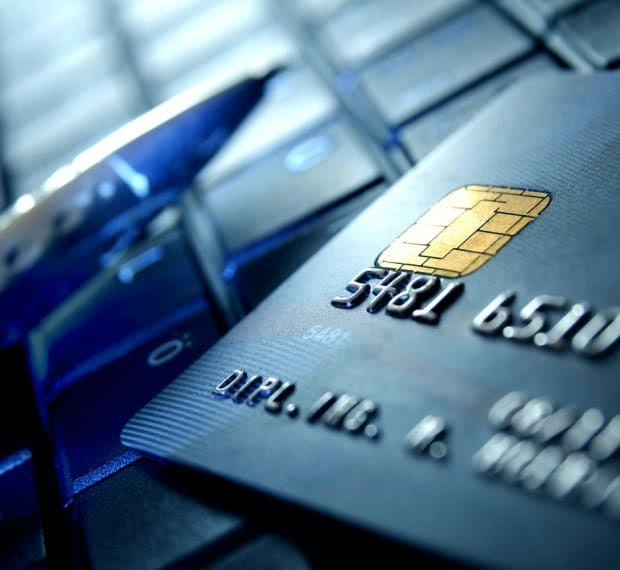
Data Breaches and Privacy Breaches: Data breaches are one of the situations where a business’s failure in the field of cyber security seriously damages trust. Data breach compromises sensitive customer information such as credit card information, personal addresses and login credentials. When customers learn that their private information has been disclosed or misused, their trust in that business is seriously damaged.
Perception of Neglect: If a business is not actively taking measures to protect its data, customers may begin to perceive it as negligence or irresponsibility. A company that does not implement basic cybersecurity protocols (e.g. encryption, strong authentication) shows its customers that it does not prioritize privacy and security. This negligence may cause customers to question the business’s commitment to their well-being and move to another business.
Reputation Damage: The consequences of security breaches can permanently damage the company’s reputation. Negative news spreads quickly on social media and comment platforms. Customers who previously trusted a business may post complaints or comments that further damage their reputation. Once reputation is damaged, it may be necessary to take years of positive steps to regain that trust.
Legal Obligations and Compliance Requirements
Every business works with sensitive data in some way. This means that every business has an obligation to ensure the security of data. Owning a business comes with many responsibilities that require your attention. As the number of urgent tasks and competing priorities increases, compliance can easily be overlooked. But ultimately compliance is a necessity, and missing it has serious consequences.
Your business’s specific compliance requirements will depend on the industry in which you operate and other factors, but there are a few relevant compliance standards every business should know.
Email Based Attacks
Phishing attacks via email are among the most common methods cybercriminals use to persuade employees to share sensitive information. Therefore, businesses should regularly train their employees on different types of phishing attacks and how to detect and report them. When a strong culture of awareness is created, employees become the first line of defense against phishing attempts.
Network Security Threats
Your networks’ connections to the internet and other shared networks make your systems and technologies vulnerable to potential cyber attacks. To reduce this risk, it is of great importance to determine clear policies and implement appropriate architecture and technical measures. Nowadays, businesses’ networks often cover more than one location, and the proliferation of mobile and remote working models and cloud services makes it increasingly difficult to define a fixed network limit. Therefore, instead of focusing only on physical network connections, it is necessary to consider where your data is stored and processed, as well as where a hacker can access this data.
Endpoint Threats
According to research, endpoint attacks are the most common types of cyber attacks. The most common goal of these cyber attacks is to launch ransomware, which affects 37% of all businesses in 2021. However, despite these increasing threats, businesses are not helpless. While malware is developing rapidly, security solutions that aim to stay one step ahead of cyber attackers are also developing rapidly. Adopting staff safety best practices and using a dedicated EDR (Endpoint Detection and Response) solution is crucial to ensuring strong endpoint security.
Endpoint attack can affect any organization, from hospitals to militaries to educational institutions. Regardless of your company’s size or purpose, your endpoints must be protected from attacks that can completely stop your activities for an indefinite period.
Network Security and Firewall Configuration
Having an approach to identifying key technology structures and processes to ensure configuration management can greatly improve the security of systems.
You need to develop a strategy to remove or disable unnecessary functions from systems and quickly fix known vulnerabilities, often by applying patches. Failure to do so may increase the risk of compromising the security of systems and information.
Enterprise Firewall Management
As cybersecurity threats become increasingly complex, hackers are trying new ways to access data every day. Therefore, to protect your networks from cyber attacks, you first need to install a firewall. A reliable system effectively protects you from brute force attacks or prevents security incidents from causing irreversible damage.
In addition, firewalls monitor your network traffic and detect suspicious activity that could compromise your data integrity. It also prevents complex spyware from accessing your systems and supports data privacy.
At this point you need to be very careful when choosing the right firewall. You should choose a system that provides full security control and visibility over your applications and networks, and you should have a modern security infrastructure as well as protection and prevention features.
Wi-fi Network Security
Because public Wi-Fi networks are often unprotected, hackers can easily intercept personal and sensitive information. Therefore, employees should be aware of cybersecurity and be informed to avoid using public Wi-Fi networks for work-related tasks. Businesses must establish secure Wi-Fi networks with encryption technologies such as WPA2 or WPA3 to protect data transfer.
Using VPN (Virtual Private Network)
Virtual private network is a technology that protects your internet connection through encryption. When a VPN is used, people on your network can send and receive data securely. At this point, the last thing you want is for your employees to use public Wi-Fi networks while working remotely. This can expose your business to any hackers in the area. By using a VPN, you can create a secure channel that encrypts information transferred from employees’ devices to your server and from your server to employees’ devices.
Endpoint Security and Device Management
Endpoint is any device that connects to your network, including physical systems and virtual environments. Common network endpoints for businesses include:
Technically, software platforms (e.g. CRM software can also be an endpoint if it accesses network resources. These are called API endpoints. Each endpoint provides an entry point into your network. To ensure strong cybersecurity, businesses need to implement strict access control for their endpoint devices.
Antivirus and Anti-malware Solutions
Antivirus software plays a critical role in protecting systems from harmful activities. Detects, eliminates or quarantines known malware in files and programs. That’s why businesses must ensure that firewalls and antivirus software are enabled and up to date on all devices and implement other cybersecurity measures as well.
Operating System and Software Updates
Keeping software and systems up to date and patching them is a simple way to prevent vulnerabilities. Vulnerability scans, penetration tests, and vendor patches are the first and most basic cybersecurity measures to prevent such data breaches.
For example, if your business uses older Android mobile phones or older Windows laptops, you need to check their devices and manufacturers.
Are there any updates that can be made on this device?
Is the device still receiving security updates?
If the laptop is no longer receiving updates because it has exited the manufacturer’s patch loop, it has a vulnerability.
Application and penetration testing from the hacker’s perspective allows businesses to detect and patch vulnerabilities before they turn into security breaches. No technology can be completely secure, and continuous application testing helps detect new vulnerabilities.
Mobile Device and IoT Security
Mobile devices can create significant security and management problems, especially when they contain confidential information or can access the corporate network. So ask users to password protect their devices, encrypt their data, and install security apps to prevent criminals from stealing information while the phone is connected to public networks. Be sure to establish reporting procedures for lost or stolen equipment.
IoT security is a method of protecting internet-connected or network-based devices. IoT technology is rapidly evolving to include thermostats, doorbell cameras, smart speakers, wearables and video game consoles. These smart and connected devices have the ability to interact with other devices, the internet, or both. Since IoT is a very large area, IoT security is also a wider area. Securing IoT requires a variety of techniques, strategies, and tools to prevent IoT from being compromised.
At this point, IoT security solutions help you identify critical assets, risks, vulnerabilities, as well as unusual or unauthorized behavior. Most importantly, in its increasingly complex technical ecosystem, you can prevent events quickly and easily before they negatively impact your business.
FAQ (Frequently Asked Questions)
Which Security Measure is Most Critical?
Improving cybersecurity starts with awareness. Most security breaches occur because a small detail, such as an old system, a reused password, or a missed update, is overlooked. Businesses can improve protection by keeping all software up to date, implementing multi-factor authentication, backing up data regularly, and performing quarterly security audits. It also helps train teams to recognize fraud and suspicious behavior. True security comes not just from hardware, but from habits.
What are the Minimum Requirements for Small Companies?
The most important security applications for a secure business are; strong passwords, multi-factor authentication, software updates, secure networks, phishing training and a security plan.
Is Cyber Security Insurance Necessary?
Because cybersecurity is one of the most important business risks today, cyber insurance is an absolute necessity for any business that depends on computer systems in any way. Because when these systems collapse, it is very difficult to carry this burden alone. After all, approximately 60’% of small businesses close within six months of being cyberattacked.
What to Do If Employees Do Not Comply with Security Policies?
If employees don’t take security policies seriously, raise awareness through engaging training that highlights the real-life impact of security breaches. Practice regular and practical exercises, such as phishing simulations. Reward those who follow the rules when determining the clear consequences of inappropriate behavior.
Are Cloud Services Secure?
Cloud services refer to technologies, policies, and practices designed to protect data, applications, and infrastructure hosted in the cloud. It ensures that your information critical to your business is accessible and protected from cyber threats and unauthorized access. Cloud security goes beyond simple password protection and includes:
- Encryption (during transfer) that ensures the security of your data by converting it into unreadable code both when it is stored and transferred
- Access controls like Multi-Factor Authentication (MFA) and role-based access to ensure only the right people have the right level of access to your data
- Threat monitoring using advanced tools to detect and neutralize threats in real time
- Compliance management that implements strict controls that comply with frameworks such as GDPR, HIPAA and SOC 2
What are the Biggest Risks in Mobile Device Use?
While mobile devices and applications have radically transformed the way businesses operate, they have also brought with them unique security risks. In this context, the five most important mobile security threats that your business should be aware of include:
- Mishing: Phishing attacks designed specifically for mobile users using SMS, in-app links, social media, voice call phishing and even QR codes. These attacks use mobile-specific behaviors to steal sensitive information.
- Mobile Malware: The number of advanced malware is increasing. 72’% of the samples detected last year were classified as zero-day threats, making it significantly difficult to detect and develop a defense against these threats.
- Platform Vulnerabilities: While Android and iOS platforms are developing rapidly, vulnerabilities are also increasing rapidly. The proliferation of CVEs and malware makes it increasingly difficult to secure devices used in different environments.
- Third Party Software: Third-party code used in app development or productivity apps purchased by businesses often lack adequate security and privacy controls. This leaves businesses vulnerable to potential security breaches.